.png)

Everest Helicopter Tour Landing Points Explained
Quick answer: An Everest helicopter tour has three landing points: Lukla (a technical refueling stop at 2,860m), Kala Patthar (the main landing and the highest point of the tour at roughly 5,545m, offering the closest possible view of Everest), and Hotel Everest View in Syangboche (a breakfast stop at about 3,880m).
The helicopter does not land at Everest Base Camp itself. It flies over or near the Khumbu Glacier area, then lands at Kala Patthar instead, which is the closest and safest ground stop with a direct line of sight to Everest's summit.
Most people booking an Everest helicopter tour assume the helicopter lands right next to Mount Everest and stays there for the whole trip. It doesn't work that way.
A typical Everest helicopter tour from Kathmandu involves three separate stops, each with its own purpose, altitude, and time limit. Knowing what happens at each one helps you understand what you're actually paying for, why the tour is priced the way it is, and what to expect on the ground.
The Three Landing Points at a Glance
Landing Point | Altitude | Purpose | Typical Ground Time |
Lukla (Tenzing-Hillary Airport) | 2,860m | Refueling stop | 10 minutes |
Kala Patthar | ~5,545m | Main landing and Everest viewpoint | 15 to 20 minutes |
Hotel Everest View, Syangboche | ~3,880m | Breakfast stop | 30 to 45 minutes |
These three stops make up the standard route used by most operators flying the Everest region out of Kathmandu, including Heli Everest's Everest Base Camp Helicopter Tour.
Stop 1: Lukla, the Refueling Point
The flight from Kathmandu to Lukla takes around 45 minutes and covers a climb from roughly 1,400m to 2,860m.
This is not a scenic stop.
It exists because a helicopter cannot carry enough fuel to fly from Kathmandu to Kala Patthar and back in one tank while also carrying passengers and supplemental oxygen.
Lukla's Tenzing-Hillary Airport is known for a short, sloped runway set against a mountainside, and it's often described as one of the more technically demanding airports for pilots. The stop usually lasts about 10 minutes.
Passengers can step out, stretch, and take a few photos of the village, but this is a working stop for the aircraft, not a sightseeing one.
Stop 2: Kala Patthar, the Main Landing
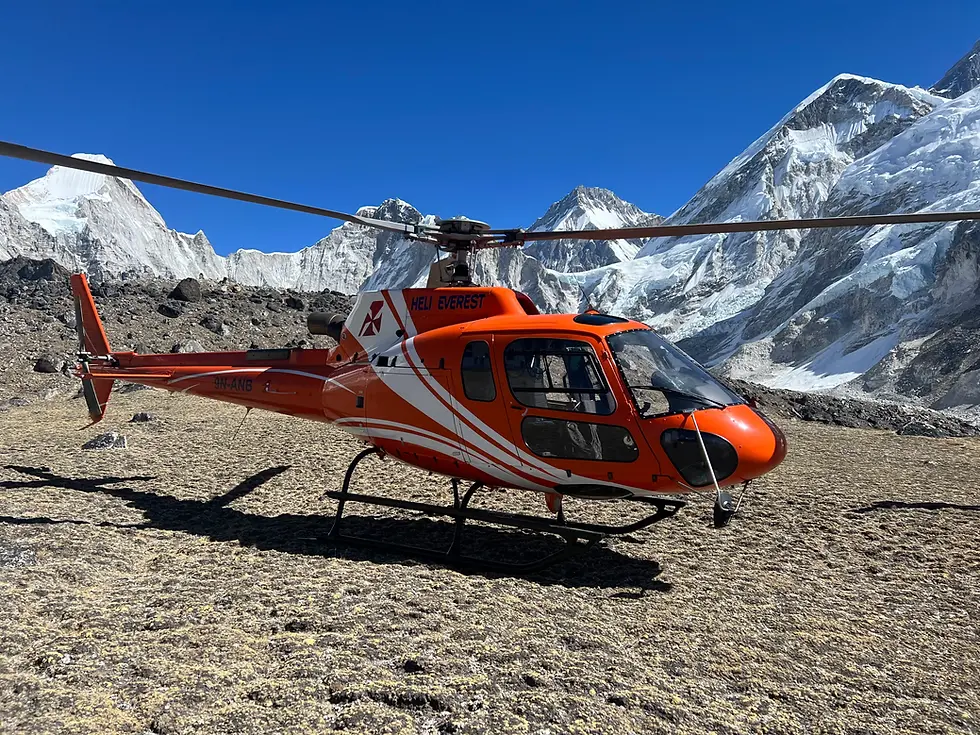
Kala Patthar is the reason people book this tour. Sitting at approximately 5,545m, it's the highest point most operators, including Heli Everest, will land a helicopter in the Everest region.
From here you get a direct, unobstructed view of Everest's summit along with Nuptse, Lhotse, and Pumori, plus a view down onto the Khumbu Glacier and Khumbu Icefall.
Ground time here is short by design, usually 15 to 20 minutes. This isn't a scheduling choice made for convenience.
At this altitude, the air is thin enough that prolonged exposure without acclimatization carries real risk, and helicopter engines are often kept running rather than shut down because of the wind and cold at that height.
Some operators offer supplemental oxygen for passengers who want it during this stop.
This is also the point in the trip where weather has the biggest influence. Kala Patthar is exposed and can cloud over quickly in the morning, which is why most Everest helicopter tours depart Kathmandu at first light, before the afternoon cloud buildup that's common in the Khumbu region.
Stop 3: Hotel Everest View, Syangboche
After Kala Patthar, the helicopter descends to Syangboche, a small airstrip above Namche Bazaar, where Hotel Everest View sits at about 3,880m. This is the tour's rest and breakfast stop. Opened in 1971, it's often cited as one of the highest-altitude hotels in the world, and it has direct views of Everest, Ama Dablam, and the surrounding peaks from its dining terrace.
This stop is where the pace slows down. Guests typically spend 30 to 45 minutes here for breakfast or tea, which also serves a practical purpose: descending from 5,545m to 3,880m before flying back to Kathmandu gives passengers a buffer against altitude-related discomfort after the Kala Patthar stop.
Does the Helicopter Actually Land at Everest Base Camp?
This is the most common point of confusion, and it's worth clearing up directly. Despite the tour commonly being marketed as an "Everest Base Camp Helicopter Tour," helicopters generally do not touch down at the base camp site itself.
Everest Base Camp sits on the moving ice of the Khumbu Glacier, and during the spring and autumn climbing seasons it's crowded with expedition tents, making a helicopter landing there impractical and generally not permitted.
Instead, tours fly over or close to the base camp area and land at Kala Patthar, which is a fixed, rocky outcrop rather than shifting glacier ice, and which actually offers a better view of Everest's summit than base camp does. Base camp sits below a ridge that blocks the summit from view, while Kala Patthar was historically used by climbing expeditions specifically because it's one of the few points where the summit is visible without climbing higher.
So when a tour is named "EBC Helicopter Tour," it means the flight route passes through and above the Everest Base Camp region, not that the aircraft lands on the base camp itself.
Why the Landing Points Affect Your Booking
A few practical things follow directly from how this route works:
Weather cancellations usually happen at the Kala Patthar stage. Since it's the highest and most exposed point, a tour can still fly to Lukla and Syangboche even on marginal weather days, but the Kala Patthar landing is the part most likely to be adjusted or skipped if visibility drops.
Altitude matters more than distance. The jump from Lukla (2,860m) to Kala Patthar (5,545m) happens in about 25 minutes of flying, which is a faster altitude gain than any trekker experiences on foot. This is why short ground time at Kala Patthar and the option for supplemental oxygen are standard practice, not an upsell.
The Syangboche stop is what makes the day comfortable. Without it, the tour would just be a short, high-stress climb and drop. The breakfast stop is timed to let passengers acclimatize slightly before descending fully back to Kathmandu.
Best Time of Year for Landing at Kala Patthar
Landing conditions at Kala Patthar depend heavily on visibility, not just wind. The clearest windows are generally in the pre-monsoon months (March to May) and post-monsoon months (late September to November), when mornings tend to be clear before cloud cover builds up later in the day. Winter (December to February) can offer very clear skies but colder temperatures and more variable wind at altitude.
Monsoon season (June to August) has the least reliable visibility due to persistent cloud cover, which is why most operators recommend booking morning departures during shoulder seasons if the summit view is the priority.
Frequently Asked Questions
How many places does an Everest helicopter tour land?
Three: Lukla for refueling, Kala Patthar as the main landing point near Everest, and Hotel Everest View in Syangboche for breakfast.
What is the highest point a helicopter lands at on this tour?
Kala Patthar, at approximately 5,545m, is the highest landing point on a standard Everest helicopter tour.
Do helicopters land directly at Everest Base Camp?
No. They fly over or near the base camp area and land instead at Kala Patthar, which offers a clearer, unobstructed view of the summit than base camp itself does.
How long do you stay on the ground at Kala Patthar?
Typically 15 to 20 minutes, kept short due to the altitude and exposed conditions at that height.
Why does the helicopter stop in Lukla?
Lukla is a fuel stop. The aircraft cannot carry enough fuel to make the full round trip from Kathmandu to Kala Patthar and back without refueling.
Is altitude sickness a concern during the Kala Patthar landing?
It can be, since passengers ascend from Kathmandu's roughly 1,400m to 5,545m within a couple of hours. Supplemental oxygen is usually available on request, and the short ground time and subsequent descent to Syangboche are both designed to limit exposure.
Can weather change the landing points during the tour?
Yes. Kala Patthar is the stop most affected by weather since it's the highest and most exposed. Lukla and Syangboche are less frequently affected.
Flying This Route with Heli Everest
Heli Everest operates the Everest Base Camp Helicopter Tour from Tribhuvan International Airport in Kathmandu as a private charter, meaning the helicopter isn't shared with other bookings. The route follows the sequence above: Kathmandu to Lukla for refueling, on to Kala Patthar for the main landing at 5,545m, then to Hotel Everest View in Syangboche for breakfast, before returning to Kathmandu. The full round trip runs about 3 hours, and supplemental oxygen is available for passengers who want it during the high-altitude stop.
If you're deciding between flying this route or trekking it on foot, it's worth reading Everest Base Camp Helicopter Tour vs Trek: Complete Decision Guide for a side-by-side comparison.
To check availability or get a quote for the Everest Base Camp Helicopter Tour, contact Heli Everest directly.

![How High Can a Helicopter Fly on Everest? Your Commercial Tour Altitude Guide [2026]](https://static.wixstatic.com/media/5da2ff_3456ba38e17648bf9571e6d149fc0ced~mv2.webp/v1/fill/w_980,h_1225,al_c,q_85,usm_0.66_1.00_0.01,enc_avif,quality_auto/5da2ff_3456ba38e17648bf9571e6d149fc0ced~mv2.webp)
Comments